Thursday, October 24, 2024
'My Old Ass:' Maisy Stella and Aubrey Plaza Lead Funny and Heartwarming Comedy-Drama
Monday, June 21, 2021
'In the Heights' Dazzles with Poignant Story and Spectacular Dance Numbers
IN THE HEIGHTS
Director: John M. Chu
Genre: Musical Drama
Starring: Anthony Ramos, Melissa Barrera, Corey Hawkins, Leslie Grace, Jimmy Smits
Distributed by: Warner Bros. Pictures
Release Date: June 10, 2021
My Rating: 9/10
When I think of predominantly Latino neighborhoods in New York City, I immediately think of the Bronx and Queens, to be completely honest. I don't think of Washington Heights, the upper Manhattan neighborhood that serves as the setting for In The Heights, the highly-anticipated musical of the summer that was postponed one full year due to the COVID-19 pandemic. The film is of course the big-screen adaptation of the 2008 Broadway musical of the same name from Lin-Manuel Miranda, the "Nuyorican" multi-hyphenate genius behind another more recent stage musical, the hip-hop sensation Hamilton.
In The Heights is set over the course of three hot summer days in the "barrio" or neighborhood of Washington Heights, leading up to a blackout that we are warned about from the very beginning of the film. The story centers on Usnavi (Ramos), a 20-something young man with dreams who came to America from his native Dominican Republic after becoming an orphan. Usnavi owns a "bodega," or small local grocery store, whom he runs with his younger cousin Sonny (Gregory Diaz IV) and tries to make the best of every day despite the humble life he leads. As the film opens, Usnavi is sitting at what appears to be a bar by the beach called "El Suenito" (The Little Dream) and is surrounded by a group of small children, to whom he begins recounting the story of his life in the NYC neighborhood, which he says always felt vibrant because "the streets were made of music."
What follows is a dazzling, vivacious opening number whose song title matches the film's name. We get introduced to all of the major characters early on, including Usnavi's friend Benny (Hawkins) who works for the cab company across the street from the bodega, Benny's boss Kevin Rosario (Smits), Usnavi's love interest Vanessa (Barrera), Kevin's daughter and Benny's romantic interest Nina (Grace), and Abuela Claudia (Olga Merediz), a kind, elderly woman from Cuba who was a grandmother-like figure to Usnavi growing up and the de-facto matriarch of the Spanish-speaking community in Washington Heights.
Although I never saw the original Broadway production and thus have no point of direct comparison, I can only judge In The Heights based on its attempts to make an entertaining film out of a musical. In this respect, the movie has undoubtedly succeeded. The soundtrack itself may not be as memorable as that of Hamilton, but the choreographed dance numbers that accompany each song are amazing. The pool and nightclub scenes, the latter of which comes just before the blackout, especially stand out in unique ways, as they are full of color and motion.
The film is also extremely timely and relevant because it addresses themes of economic struggles, prejudice, and the American Dream. When the film begins, Nina has returned home from Stanford University and announces to her father and her friends at a local barbershop that she has decided to drop out, much to the dismay of everyone ("No me diga!" or "I can't believe it!" they all respond). Nina sings about the pressure she feels for being treated like the pride and joy of her community because she "made it out" and was able to continue her education by being admitted to an elite college. We then learn that a major contributing factor to Nina's decision was her feeling lonely and like an outsider. More specifically, she reveals, she was often discriminated against for being Hispanic in a predominantly white environment. She opens up about two distinct incidents that made her realize she didn't belong in this new world: a fellow student mistook her for a waiter at an elegant dinner at the university, and her white roommate and her family wrongly accused her of stealing jewelry.
Today, in real life, there are undoubtedly millions of non-white college students (and young people, more generally speaking) across the United States who still experience the same emotions Nina does when they enter a new environment. There is also a brief scene of a protest against the deportation of "Dreamers," or immigrants who came to the U.S. as children- this ties into the story's theme of dreams. The Obama-era DACA (Deferred Action for Childhood Arrivals) policy is mentioned, which demonstrates that the script for the film was adapted to reflect more current issues than the ones that existed when In The Heights first appeared on Broadway (which is when Obama was running for president). Sonny is shown to be crestfallen after learning he is unable to get a college education because he is undocumented. However, he is committed to protesting and speaking out to the injustices he perceives. In the pool scene, he and many others sing about what they would do with $96,000 after Usnavi's bodega sells a winning lottery ticket. "The rich are penetrating, we pay our corporations when we should be demonstrating," Sonny angrily laments. "What about immigration? Politicians be hating', racism in this nation's gone from latent to blatant." That final lyric was likely poignant when In the Heights originally came out on Broadway but is indisputably more accurate today: if that's not a reflection of the current political climate in the post-Trump era, I don't know what is.
There is also the great sense of national pride that is reflected in the post-blackout scene that includes the two songs "Carnaval del Barrio" ("Party in the Hood") and "Alza la Bandera" ("Raise the flag"). As the residents of Washington Heights sit around moping about the scorching weather, salon worker Daniela (Daphne Rubin-Vega) indignantly exclaims, "Since when are Latin people scared of heat?!" and a big, impromptu dance party begins as dozens of residents proudly waive their nation's banners, and we see glimpses of the Puerto Rican, Dominican, and Mexican flags, among others. It's rare to see something like that in any major Hollywood film, even today.
In the Heights did not do well at the box office, which was likely disappointing to many people involved with the film. However, it was simultaneously released on HBO Max, which many individuals likely chose as their viewing preference given the fact that they can watch the film from the comfort of their home. (Netflix has gained a significant number of subscribers since the pandemic, it's no surprise if HBO's streaming service follows suit.) Nevertheless, the film may have gained something even more meaningful than record ticket sales: the honor of being the first major Hollywood musical film of the 21st century to feature a predominantly Hispanic/nonwhite cast. The movie was even presented at the Tribeca Festival in Washington Heights this year and at other film festivals around the country in areas characterized by a large Spanish-speaking community.
Yes, Miranda and the crew behind the film received criticism for its lack of Afro-Latino actors in the main cast, as these individuals represent a substantial component of Washington Heights. But the truth is that this adaptation of In the Heights remains a huge step forward for Hollywood and could likely pave the way for similar projects in the coming years. Miranda acknowledged the film's shortcomings with regards to representation and responded to the rebukes of "colorism" in his typical eloquent, humble, and respectful manner, which I believe provides a sense of optimism. In the Heights is all about dreams, and hopefully audiences learned to dream in little or big ways after watching this beautiful story unfold on the screen.
Sunday, February 14, 2016
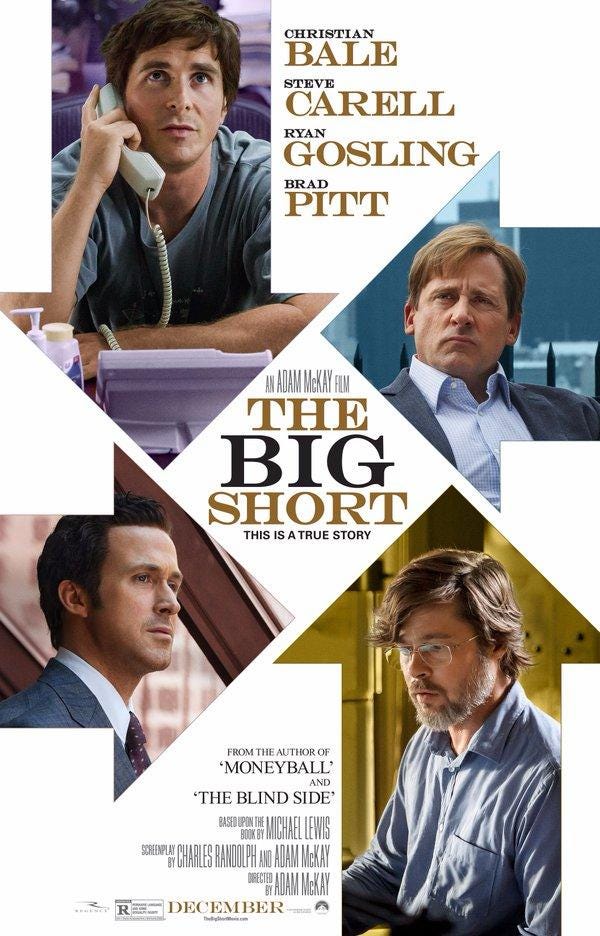
'The Big Short' Proves To Be Nothing Short Of A Big Triumph
Director: Adam McKay
Genre: Biographical Comedy/Drama
Starring: Christian Bale, Steve Carell, Ryan Gosling, Brad Pitt, Marisa Tomei, Melissa Leo
Distributed by: Paramount Pictures
Release Date: December 11, 2015
My Rating: 8.5/10
I've seen, heard and read a lot of explanations about the gigantic financial meltdown and "housing bubble" that hit the United States--and the rest of the world too, for that matter--during the late 2000s. Thanks to graph and statistic-laden explanations from professors in college, documentaries like Inside Job, movies like HBO's Too Big To Fail, or even simply dinnertime reports from my father, who just so happens to work in the banking industry, I've come to grasp the basic understanding of what exactly occurred during this 2008 crisis, as well as its causes and consequences (or lack of consequences).
None of these accounts proved to be as clear or as entertaining as the one presented by Director Adam McKay's (Anchorman, Step Brothers) biographical dramedy, The Big Short, based on Michael Lewis's (The Blind Side, Moneyball) nonfiction book of the same name. The film tells the story of a few visionary guys who essentially bet against the US housing market and the American economy as a whole by 'shorting' bonds, subprime mortgage loans and other types of securities. 'Shorting' refers to selling securities not owned by the seller (borrower) with the belief that the price of that security will eventually decline, thus allowing it to be repurchased at this lower price for a profit. Thus, a new market was created to get a tool for shorting: the market of credit default swap (CDS), a type of financial exchange between a seller and a buyer (lender) that serves as a form of insurance against the defaulting of a loan.
The main players of the betting game: Dr. Michael Burry (Christian Bale), a neurologist turned hedge fund manager of California-based Scion Capital with Asperger's Syndrome and an artificial left eye, who was essentially the first on Wall Street to foresee the bursting of the housing bubble and thus made a profit by throwing over $1 billion of his investors' money into credit default swaps. FrontPoint Capital hedge fund manager Mark Baum (Steve Carell, based on real-life manager Steve Eisman), cynical Deutsche Bank bond trader Jared Vennett (Ryan Gosling, based on Greg Lippmann), and jaded former JP Morgan Chase Bank trader Ben Rickert (Brad Pitt, based on Ben Hockett), who worked at the major bank's office in Singapore and was pessimistic about the banking industry.
Vennett approaches Baum about shorting collateralized debt obligations (CDOs), groups of asset-backed securities that are basically a promise to pay investors in a prescribed sequence of 'tranches' or portions based on the cash flow the CDO collects from the pool of assets it owns. Vennett explains to Baum and the rest of his team at FrontPoint that these CDOs have been packaged together and incorrectly assigned very high AAA ratings by agencies like Standard & Poor, which leads the ragtag group of Wall Street hotshots to pull off one of the greatest heists in decades.
Although I have not read Lewis's book, the script (from Mr. McKay and Charles Randolph) is superb, without a doubt. Perhaps what I found most engaging about the film was the inclusion of random celebrity cameos (as themselves) to simplify the explanation of the basic definition and functioning of financial instruments and transactions: from Australian actress Margot Robbie explaining subprime mortgages in a bathtub, to chef and TV personality Anthony Bourdain using seafood to describe CDOs, to pop star Selena Gomez describing 'synthetic' CDOs (essentially CDOs piggy-backing on other CDOs) while playing blackjack in a casino. Yes, you read all of those correctly.
Some may find it patronizing to use celebrities and simple analogies to 'dumb-down' these highly technical concepts, but I found it very fun and refreshing. These lighter scenes provided a more-than-welcome relief from the narration (mostly from Mr. Gosling's character) and conversations between the protagonists, which quite frankly revealed a lot of depressing information about the collapse of the American and world economies. The interspersing of quotes that were not stated but shown across a black screen, both anonymous and from famous folks, also helped to provide straightforward analogies for the crisis.
If celebs like the above three are what it takes for people to pay more attention, then so be it. As Mr. Carell's character tells his wife (Marisa Tomei) over the phone, complaining about how nobody cares about all of this, not even those who know they're being ripped off: "They're being screwed, you know. You know what they care about? They care about the ball game, or what actress just checked into rehab." And he's right. Most people who pass by us everyday may have no involvement with this industry and could not care less about it.
The performances are very sincere and reflect the varying emotions and opinions all of these top bank and hedge-fund leaders expressed during the meltdown. Mr. Carrel proves once again, following his Oscar-nominated role in 'Foxcatcher,' that despite his long resume as a funny man, can also brilliantly tackle much more dramatic roles. He does not shy away from demonstrating the frustration men like his character, and Mr. Pitt's character, felt at the demise of the industry, and more specifically at its lack of honesty and integrity, which Burry talks about in narration form at the end of the film.
Mr. Pitt's scolding of two young, ambitious, twenty-something guys (John Magaro and Finn Wittrock) who celebrate after they realize how much profit they are going to make from the big short operation encapsulates so much about the film: "Do you have any idea what you just did? You just best against the American economy. People are going to lose their homes, their jobs."
Oscar Winner Christian Bale also immerses himself beautifully into the character of the real-life, eccentric, and socially awkward yet oddly likable Michael Burry, the visionary genius who predicted the entire collapse and who did not let anyone, not even his superiors, stop him from believing he was right. His case proves that even the strangest people, with the oddest, out-of place habits like blasting heavy metal, playing with drumsticks, and wearing a t-shirt and no shoes, can be the outsiders we need to bring to light the importance of a severe issue.
The Big Short is now nominated for five Academy Awards: Best Picture, Best Director, Best Supporting Actor for Mr. Bale, Best Adapted Screenplay, and Best Film Editing.
Tuesday, February 9, 2016
Room: A Film With A Small Setting And A Larger-than-Life Impact
ROOM
Director: Lenny Abrahamson
Genre: Drama
Starring: Brie Larson, Jacob Tremblay, Sean Bridgers, Joan Allen, William H. Macy
Distributed by: A24 Films
Release Date: October 16, 2015
My Rating: 9.5/10
Every now and then, a movie comes along that is so powerful you feel like you are riding a roller-coaster of emotions throughout the entire viewing: fear, heartbreak, joy, all in the span of under two hours. The 2015 film that reflects that description the most, for me, is the Oscar-nominated indie Room.
From Irish director Lenny Abrahamson comes the adaptation of fellow Irish-Canadian novelist Emma Donoghue's 2010 book of the same name. Miss Donoghue writes the screenplay for this beautiful and heart-wrenching film about the love between a young mother and her son, and their struggle to attain freedom.
The film follows 24-year-old Joy "Ma" Newsome (Brie Larson), a young woman who has been held in captivity in a tiny backyard shed for seven years, along with her five-year-old son, Jack (Jacob Tremblay). The man who has kept them there: a monster they refer to as 'Old Nick' (Sean Bridgers), who appears to be Joy's neighbor, and who only provides her and Jack with food and other basic necessities. Old Nick repeatedly rapes Joy in the shed that only has one opening in the ceiling that allows skylight, and that houses one small kitchen and a side room with a bed and bathroom, which leads Jack to affectionately refer to their entire home as 'room.' After several attempts to escape the shed with Jack, the two are finally set free after a clever plan from Joy, and are taken in by her parents (William H. Macy and Joan Allen).
Joy and Jack slowly learn to adjust and live a normal life in Joy's parents' home in the real world.
Before I say anything else about this movie, I should make two things clear for anyone who hasn't yet seen it. First, there are no explicit rape or abuse scenes: this is only implied. Second, only the first 45 minutes or so of the film take place inside the actual 'room,' for all you claustrophobic folks out there. As a matter of fact, one of the most intense scenes, for me, occurs after the two protagonists are released from their confinement.
The first thing that must be noted is Brie Larson's performance, which is beyond stellar. From every smile, look of frustration, scream, and sobbing plea, Miss Larson immerses herself completely into the role of a mother who is willing to risk everything to break free from her prison and provide a normal life for her and her son. Jacob Tremblay also proves to be a stellar young performer, capturing the innocence and unbridled curiosity of almost any child, even one who may have been raised in such abnormal and oppressive circumstances. This is the first film (that I've seen in theaters) in a very long time that has brought tears to my eyes, which I quickly wiped away because I remembered I was in a public place. When a film does this, and then nearly causes you to cry a second time (for joy), you know it was poignant as hell. That might even be an understatement.
Although I haven't read the original novel, the script is certainly beautifully written: no line of dialogue or scene appears out of place in the slightest. This can likely be attributed to the fact that the author of the novel also serves as the screenwriter. Miss Allen also delivers a strong performance as a woman dedicated to caring for and protecting her long-lost daughter and grandson.
Going to see a film like Room may not be a pleasant way to spend two hours, but truly great art is not always about comfort. It's about telling a story that appeals to any of our raw emotions and makes us ask questions about why people make certain decisions or refuse to make them, how people can be so evil and others purely kind and determined to succeed and attain the happiness they deserve. Is this a far-fetched and exaggerated story? Maybe. Maybe some people have been locked in a shed before, although not for seven years. Nevertheless, this thought never even crossed my mind until well after I left the theater and more importantly, the possibility of the answer to this question being yes does not in any way diminish my view of this story.
Room has now been nominated four Oscars: Best Picture, Best Director, Best Adapted Screenplay, and Best Actress for Brie Larson. With a Golden Globe for Best Actress in a Drama and a Screen Actors Guild (SAG) Award for Best Actress already under her belt, the Academy Award for Best Actress will surely soon find itself in Miss Larson's hands as well. She certainly earns my vote for it.
Thursday, January 28, 2016
From Ireland to Brooklyn, New York: A Young Girl's Journey Across The Pond
Director: John Crowley
Genre: Period Drama
Starring: Saoirse Ronan, Emory Cohen, Domhnall Gleeson, Julie Walters, Jim Broadbent
Distributed by: Fox Searchlight Pictures, TSG Entertainment
Release Date: November 6, 2015
My Rating: 9/10
The Oscars are exactly one month away, so here is my review on the fourth film nominated for Best Picture this year that I've had the pleasure to see so far, one which left me very satisfied.
Irish director John Crowley (Intermission, Boy A, Closed Circuit) brings to the screen an adaptation of Colm Toibin's novel of the same name, while author Nick Hornby (High Fidelity, About a Boy) pens the screenplay.
Oscar Nominee Saoirse (pronounced 'ser-shuh,' like 'inertia') Ronan (Atonement, Hanna, The Host) stars as Eilis (Pronounced 'Ay-lish') Lacey, a young girl from a town in southeast Ireland called Enniscorthy who works at a small shop run by a sour woman named Miss Kelly in 1952. One day, Eilis's older sister Rose arranges for her to travel to the US so that she may find a better life.
Thus, before she can even fully process the weight of her journey, Eilis boards a ferry and travels to Brooklyn, New York, which she soon discovers is home to many other Irish immigrants like her who have family in their home country. She begins living in a boarding house run by an Irish landlady named Mrs. Kehoe (Julie Walters from the Harry Potter films) along with several other girls around her age, both Irish and American, and aspires to become an accountant. Eilis also begins working at a department store, although her initial shyness renders interactions with customers difficult.
At an Irish dance, Eilis also meets a young, hip Italian-American boy named Tony Fiorello (Emory Cohen) who works as a plumber. She soon begins dating Tony, and in addition to her job, is enrolled in bookkeeping classes at a local college thanks to help from a friendly Irish priest from back home named Father Flood (Academy-Award Winner Jim Broadbent). Eilis thus begins to feel more accustomed to life in New York. However, after a family tragedy forces her to return home, Eilis becomes the recipient of another young man's advances: a boy named Jim Farrell (Domhnall Gleeson from About Time, Ex Machina). Eilis is quickly forced to choose between two men and two lifestyles: her traditional life in Ireland, or her promising new life in America.
Two aspects of this movie stood out the most for me: the portrayal of the era, and the lead actress's performance. I am of course much less familiar with the way Ireland was during this time, although the depiction of 1950s New York is uncannily similar to many pictures I've seen and texts I've read across the years: from the brightly colored clothes and traditional bathing suits, to the old, shabby apartment buildings and cars.
Miss Ronan undoubtedly carries the film with a heart-wrenching and sincere performance which has earned her an Oscar Nomination for Best Actress, her second after her first nomination for Supporting Actress for Atonement in 2008 at the tender age of 13. It is clear that she is a versatile actress whose film career, despite being relatively recent, has already proven her prowess for playing a wide range of characters. From a lethal assassin to a girl possessed by an alien, to a rebellious, sharp-tongued American girl living in war-torn England, and now to a good-mannered, polite and proper Post-War-Era Irish girl immigrating to New York, Miss Ronan has certainly demonstrated her star power as a foreign actress in Hollywood.
In every major scene in Brooklyn, Ronan displays with unwavering excellence the various emotions her character experiences throughout her journey as she is questioned, controlled, and beaten down by many of the people around her: fear, joy, sorrow, confidence. In the end, Eilis represents the modern-day 'miss independent,' (even if the film does not take place in modern times) who ignores others' desires for her and chooses the life her heart is telling her to pursue, and Saoirse Ronan elegantly displays that.
The script is also very meticulously written, (Hornby is also nominated this year for an Oscar for Best Adapted Screenplay) and although I have not read Mr. Toibin's novel upon which the film is based, nearly every scene and exchange of dialogue is crafted with care, giving each major character life and demonstrating the weight of this drama. Even the few lighter, more comical moments that are interspersed throughout the film are clever.
Miss Ronan's film career will undoubtedly continue upwards after this role, and (aside from the fact that I may have just completely fallen in love with her) I am sure she will be given the opportunity to play several more memorable roles.
Saturday, November 28, 2015
'Spotlight' Sheds Heavenly Light On Boston Archdiocese's Great Abuse Tragedy
Director: Thomas McCarthy
Genre: Drama
Starring: Michael Keaton, Mark Ruffalo, Rachel McAdams, Brian d'Arcy James, John Slattery, Liev Schreiber, Stanley Tucci
Distributed by: Open Road Films
Release Date: November 6, 2015 (limited)/November 20, 2015 (wide)
My Rating: 9.5/10
"When you're a kid from a poor family and a priest pays attention to you, you feel special. How do you say 'no' to God, right?" This is just one of the many lines that encapsulates the victim's perspectives in a large-scale abuse scandal like the one dealt with in Spotlight. I sincerely hope this film wins, or at least is nominated, for several Oscars and other film awards because it absolutely deserves them. (I must admit bias, as I am an avid fan of investigative journalism dramas based on real events, like All The President's Men, Shattered Glass, and Kill The Messenger.) Writer/Director Tom McCarthy's (The Station Agent, The Visitor) drama, based on real events, centers on the Boston Globe's eponymous team of investigative journalists who, piece by piece, garnered evidence on a series of cases of priests from the Archdiocese of Boston who were molesting little children, particularly boys.
Set in 2001, the film begins with the arrival of Jewish editor-in-chief Marty Baron (Liev Schreiber), who takes over after leaving The New York Times, which incidentally bought the Globe a few years prior. After receiving a tip on a story about a priest named Geoghan who supposedly molested a young boy in his parish years ago, the Spotlight Team, led by Walter 'Robby' Robinson (Michael Keaton) begins a full investigation into how many other identical or similar cases there were within the Archdiocese of the city they grew up in. Their quickly research leads them to initially believe 13 priests committed these foul sexual crimes. However, multiple phone interviews with an ex-priest and psychotherapist named Richard Sipe (Richard Jenkins), who treated the priests who were discovered and subsequently sent to a psychiatric hospital, reveal there may have been up to 90 accused clergymen within the city of Boston alone, which roughly matches a national statistic that estimates six percent of priests are pedophiles.
The team manages to confirm 87 priests' names, and after multiple interviews with victims, lawyers, and even members of the Church, the Boston Globe pursues a lawsuit against the religious institution and its leader, Cardinal Bernard Law (Len Cariou).
The film is beautifully shot, and boasts a meticulously written script that alternates speed and pacing in a way that helps to maintain the audience's attention. The score is also very eerie and helps set the tone for a suspenseful storyline. The scenes that involved cross-cutting between different victims' interviews with the Spotlight Team (and, as one can imagine, with characters finishing each other's lines) were some of my favorite. The confessions of the victims are beyond shocking and utterly heartbreaking, especially knowing that they were ignored for so long, (20-plus years in some cases) even if part of the reason for that was that these boys were ashamed to speak out. One of the victims, Phil Saviano (Neal Huff), who states the aforementioned quote, also angrily asks the team of reporters why they ignored a box filled with evidence of abuse he had sent the Globe five years prior.
A lawyer named Mitchell Garabedian (Stanley Tucci) whom Spotlight reporter Michael Rezendes (Mark Ruffalo) constantly perturbs for information, claims that this case is particularly difficult because "the Church controls everything." One of the lawyers who defended the accused priests, Jim Sullivan (Jamey Sheridan), angrily explains when confronted that he was simply "doing his job." Finally, one of the attorneys who defended the victims, Eric MacLeish (Billy Crudup), also becomes defensive and refuses to remotely divulge any piece of information or take any responsibility, saying these types of cases are generally hopeless. So how much true progress and justice can really come when so many turn a blind eye and few seem willing to admit the truth or take the blame?
The performances from the all-star cast are outstanding and reflect their respective characters' perseverance and determination to uncover the truth and not let this story go unheard, despite another major event rocking the country at one point of the more-than-a-year-long investigation: 9/11. The most prominent performances for me were those of Mr. Keaton, Mr. Ruffalo, and Rachel McAdams, who plays the only female reporter on the Spotlight Team, Sacha Pfeiffer. Funny enough, Ms. McAdams' character is also the only one in the entire film who is shown directly interviewing an accused priest, who clearly seems mentally ill.
Aside from the shots of Boston's landmarks which unsurprisingly made me immensely miss my college city, the shots of the city, particularly during the wintertime, are perfect for such a dark tale.
Truth be told, I couldn't help but feel slightly ashamed as a Catholic after watching this film. I remember hearing of a few real-life cases of child molestation by clergymen in high school and in college, but I never truly realized the size and scope of this scandal until watching this film. To learn that, although justice was served in many cases, many others remain unfinished, is even more horrifying. The end credits reveal the cities both in the US and in the rest of the world where such scandals have erupted, and believe me when I saw your jaw will drop when you see just how many cities are on this list.
The fact that the judge assigned to the main case in which the Church was sued, Constance Sweeney, was a devout Irish Catholic woman, and that this woman ruled against the Church, is indisputably significant. Furthermore, nobody seemed interested in pursuing this story until a new editor who wasn't Catholic showed up and pushed for the investigation, because as one character states, "it takes an outsider," an opinion I happen to agree with. As for the accuracy and authenticity of the film's events, facts and statistics, the reporters from the Globe involved in the investigation were scrutinized by other journalists. The Spotlight Team members also published a book based on their findings entitled Betrayal: The Crisis of the Catholic Church.
Of course, not all priests are pedophiles or criminals of another nature. Just like police officers, some are merciless (and perhaps mentally ill), but many others are also good people. I make this comparison due to the increasing number of cops who have been shooting or violently arresting unarmed black men across the country and are defacing our society's image of policeman. Both priests and cops are figures who are supposed to represent all that is good, yet who is ensuring that they don't abuse of their rights or authority? Sadly, there seems to be a long way to go in both of these issues, although I am confident that big changes will come, even if it is not in the most drastic of ways.
Wednesday, November 4, 2015
Tom Hanks Shines As Key Facilitator In 'Bridge of Spies'
Director: Steven Spielberg
Genre: Historical Drama
Starring: Tom Hanks, Mark Rylance, Amy Ryan, Alan Alda
Distributed by: Touchstone Pictures (North America), 20th Century Fox (International)
Release Date: October 16, 2015
My Rating: 7.5/10
Legendary filmmaker Steven Spielberg is back as both Director and Producer of yet another 20th-century war drama. Although this film does not take place during World War II like Saving Private Ryan, Schindler's List, Flags of Our Fathers, or Letters from Iwo Jima, this film is set in 1957 during the height of the Cold War, which arose in large part due to the aftermath of the Second World War.
Two-time Academy-Award-winner Tom Hanks stars as Jim Donovan, an insurance lawyer from Brooklyn who is tasked with the highly controversial task of defending Rudolf Abel (Mark Rylance), a Soviet spy, who is also a British Citizen, who has just been arrested in New York after FBI agents storm his apartment and find evidence of his illicit activities.
Many American officials and even civilians fear Abel may be a KGB spy, but work hard to ensure his trial is fair so as to avoid another reason for escalating tensions between the US and the Soviet Union.
As one might expect during that time, Donovan quickly becomes despised by the American public, and he and his family slowly become threatened. The lawyer remains persistent, and continues his attempts to convince the courts to give Abel 30 years imprisonment rather than a direct death sentence, but fails.
Meanwhile, a young pilot named Francis Gary Powers (Austin Stowell) is shot down from his U-2 spy plane over the Soviet Union, where he is captured, imprisoned, and tortured. Another young American, an economics graduate exchange student named Frederic Pryor who is working on his dissertation in East Germany, is also detained and held hostage shortly afterwards following a visit to his German girlfriend in East Berlin just as the Berlin Wall is being constructed. Thus, Donovan attempts to negotiate a 2-for-1 trade with the USSR: Abel for both Powers and Pryor. The USSR only agrees to return Powers, which prompts Donovan to fight till the bitter end until both him and Pryor are home safe.
Bridge of Spies is certainly a very well-shot war thriller, with both dreary, grey shades during the winter in present-day Russia and brightly-colored outfits that bring the 1950s completely to life (especially in the case of Donovan's wife and daughter, played by Amy Ryan and Bono's real-life daughter Eve Hewson). The tensions between the two major superpower nations are vividly depicted-despite the occasional comic relief in one-on-one conversation scenes-and the display of people illegally jumping over the Berlin Wall at night fresh off its construction, only to be shot by Soviet/East German police, are shocking.
Tom Hanks delivers his usual outstanding performance of a man who is nothing short of perseverant, albiet fierce opposition from his own compatriots. Support from a strong cast and a well-penned script from the Coen Brothers and Matt Charman help to round off a story that in the end truly does demonstrate how drastically differently both nations operated during this tumultuous Cold War. The fact that Donovan is ultimately granted the majority of the credit for the exchange, while Abel does not even remotely appear to be welcomed back to his homeland with open arms. Likewise, Powers is depicted as undergoing through much more violent interrogation sessions from the Soviets than Abel is by the Americans: bias? Probably. Donovan is revealed to have also played a large role in negotiating the exchange of prisoners during the Bay of Pigs Invasion just a few years later in 1962, which may be another reason why he is so revered in this film.
The film is rather long, with a total running time of 2 hours and 21 minutes, and the negotiations do seem to drag on for the latter half of the story, and the ending is more anti-climactic than some may like, so although you might leave the theater disappointed in this regard just remember that you were warned.
I hope to see more of Mr. Spielberg's work in the coming years, whether it take the form of another war drama or a more sci-fi/adventure blockbuster that recalls old classics like the beloved Indiana Jones and Jurassic Park franchises.
Wednesday, October 21, 2015
Saving Jason Bourne/Will Hunting/Prviate Ryan... In Outer Space? Count Me In!
Director: Ridley Scott
Genre: Science Fiction, Drama
Starring: Matt Damon, Jessica Chastain, Michael Pena, Jeff Daniels, Chiwetel Ejiofor, Kristen Wiig
Distributed by: 20th Century Fox
Release Date: October 2, 2015
My Rating: 9/10
In all sincerity, I've been disappointed by the last few string of intergalactic sci-fi flicks that have been thrust full throttle onto the big screen in recent years. Alfonso Cuaron's Gravity (2013) was decent, with a great cast and splendid visuals, but not completely satisfying and dubiously realistic (not to mention an unsatisfying, grandiose ending). Clearly, The Academy loved it, since it snagged seven out of ten Oscars, including Best Director and Best Visual Effects.
Christopher Nolan's uber-lengthy space-set blockbuster Interstellar (2014) left me even more vastly disheartened, despite its equally stunning panorama of futuristic landscapes and special effects and A-list cast. (Also, far too much crying)
However, acclaimed director Ridley Scott (Gladiator, Prometheus) engenders a brilliant thrill ride in The Martian, which is based on Andy Weir's 2011 novel of the same name. The film revolves around Mark Watney (Damon), an astronaut who becomes stranded on Planet Mars after a dust storm strikes, which leads his five fellow crew members (Jessica Chastain, Michael Pena, Kate Mara, Sebastian Stan, Aksel Hennie) to abandon him and return to Earth.
Using his wide array of skills as a botanist and engineer, as well as his morbid sense of humor, Watney learns to adapt to the desolate environment on Mars. He records video logs of his survival progress, which he eventually manages to send to NASA after an initial struggle to establish communication with them. Both his crew and NASA's top executives, among them Head Director Teddy Sanders (Daniels), Media Relations Director Annie Montrose (Wiig), and Mars lead mission director/engineer Vincent Kapoor (Ejiofor), scramble to employ ever resource and strategy available, including the assistance of China's National Space Association, to rescue Watney and return him home safely.
Matt Damon (my favorite actor of all time) is outstanding as the optimistic and somewhat snarky Mark Watney. Recalling his roles in the Bourne trilogy, The Adjustment Bureau and many other movies, Mr. Damon immerses himself completely in the role of this multi-talented man who traverses hell and back to reach his final destination. The rest of the star-studded cast also form a magnificent ensemble, with A-list Oscar-nominees Jessica Chastain portraying Melissa Lewis, the valiant and determined Commander of Watney's crew and Chiwetel Ejiofor as the cautious and brilliant Mars mission leader Vince Kapoor. Jeff Daniels channels the same vigor and nonsense-intolerance of his character from his hit HBO series The Newsroom, anchor Will McAvoy, to bring NASA Head Teddy Sanders to life.
Although the visuals of the red-tinged wasteland that is supposed to be Mars are fantastic, the film is not solely defined by them. The score and soundtrack are equally entertaining, particularly the latter. I haven't seen every major/classic space-set sci-fi movie in the history of film, but I'm willing to bet Bill Gates levels of money that this is the only one to include a setlist of mega-corny 70s disco tunes and other classic oldies, from Gloria Gaynor, to Donna Summer, to Gloria Estefan. If the thought of Matt Damon rebuilding a space vehicle while ABBA's "Waterloo" plays in the background doesn't appeal to you, then you can't possibly be a very happy person. Unfortunately, Train's "Drops of Jupiter" doesn't make the cut. Maybe in the sequel.
The script remains substantially true to Weir's novel, with a few minor details omitted, including much of the profanity uttered by characters like Watney and Annie, presumably to justify a PG-13 rating and attract younger audiences. The doses of humor, including Watney's complaints of going seven days without any ketchup for his meals, and his claims of colonizing Mars by being the first human to grow potatoes, with a smug "in you face, Neil Armstrong," to tack it off, keep you as engaged in the story as much as the protagonist is determined to return home safely.
All of these elements contribute to making The Martian a spectacular film that any viewers who remotely enjoy astronaut flicks will remember from beginning to end. Some scientists have claimed that the storyline is very unrealistic in certain respects, while Mr. Damon referred to it as 'science faction.' A few film buffs have described the film as a cross between Apollo 13 and Cast Away, although I believe that the film is meant to be much more. Should Mr. Scott decide to helm yet another upcoming sci-fi film with a similar cast and similar themes, I will be sure to look out for it. In the meantime, go see this film to find out if the the talented Mr. Watney does indeed survive.
Thursday, October 15, 2015
Welcome to Juarez: City of Drugs, Bones, and Sicarios
SICARIO
Director: Denis Villeneuve
Genre: Crime Drama/Thriller
Starring: Benicio del Toro, Josh Brolin, Emily Blunt, Victor Garber
Distributed by: Lionsgate
Release Date: September 18, 2015 (Limited), October 2 (Wide)
My Rating: 9.5/10
From French-Canadian director Denis Villeneuve (Incendies, Prisoners) comes a bloody, gut-wrenching crime thriller that surely makes the list of my favorite films of this year, and which will hopefully become an Oscar contender.
The title of the film derives from the Spanish word for 'hitman,' a term frequently used in Mexico to describe any type of hired assassin. The film opens up with an explanation of the original meaning of the word Sicario, which dates back to the times of the Ancient Romans, and referred to the zealots of Jerusalem who would give the hunting game to the Romans who had invaded their land. The story centers around Kate Macer (Blunt), an idealistic FBI Special Weapons and Tactics Team agent who is tasked with assisting CIA agent and DOJ adviser Matt Graver (Brolin) and his dubious partner Alejandro (del Toro), who was previously stationed in Colombia, with a mission. This mission consists in bringing down a drug cartel leader named Manuel Diaz, who leads them in turn to an even bigger drug lord named Fausto Alarcon. As the investigation across the U.S.-Mexican border escalates, Kate begins to question the morality of the means being employed, and suspects there may be a double-agent in their midst.
The film is brilliantly shot and laden with gruesome images from the very beginning. I would not be surprised if I learned that some of the photos of decimated and mutilated bodies were completely real. Although the film is rather slow at the start, (after the opening action scene) the magnitude of the mission escalates, as well as the tension between the US government officials, and the body count rises rapidly in the second half of the film. Coupled with an eerie and heart-pounding score by Icelandic composer Johann Johannsson, (Prisoners, The Theory of Everything) low-key lighting, and first-person-shooter-video-game-esque green lights as seen through special high-tech CIA goggles as the squad travels through tunnels in Mexico searching for the drug lords, Sicario truly makes for a macabre, contemporary thriller.
Emily Blunt delivers a commanding performance as a brave, badass, take-no-nonsense government agent despite her supremely feminine appearance. Her emotions take a constant turn from suspicion, to terror, to pure anger as she cruises back-and-forth across the border donning nothing but a plain dark tshirt, pants, boots, a bullet-proof vest, and a simple handgun, as well as the occasional cigarette to relax the nerves (or to fit in better with the men?). Josh Brolin is brilliant as the obligatory sarcastic knucklehead team leader whose morals seem questionable from the get-go.
Benicio del Toro is phenomenal as a frightening, yet cool-under-dire-situations man who has suffered personal loss and is just as tenacious as Miss Blunt's character to seek justice, albeit for a different problem and by different tactics. Mr. del Toro, a native Puerto Rican, seamlessly alternates between English and Spanish, and squints his small eyes as he issues threats in a gruff tone. One of the many aspects of the film that undoubtedly made chills run down my spine was hearing del Toro deliver some of his lines before beating or killing a stuck-up yet not-so-smart drug-pusher. The coldest one: "Ahora vas a saber lo que es conocer a Dios en tierra Yanqui." ("Now you will know what it's like to meet God in Yankee territory").
The film ends on a horrifying note, shedding nothing close to a ray of hopeful light with regards to the increasingly precarious cross-border war on drugs. The plot twist towards the end of the film demonstrates that there are clearly more than simply two sides to this issue. Who knows when the dispute will finally end, but one thing is certain after seeing Sicario: in Juarez, Mexico, anything goes, and only those with the nerve to take risks and play dirty will survive.
Friday, September 4, 2015
'The Man from U.N.C.L.E' Stands for 'Uneventful, Non-Creative, Lackluster Experience'
Director: Guy Ritchie
Wednesday, August 19, 2015
Jason Segel Electrifies 'The End of the Tour'
Genre: Drama
Starring: Jason Segel, Jesse Eisenberg, Joan Cusack
Distributed by: A24 Films
Release Date: July 31, 2015
My Rating: 9/10
What do you get when you mix genius, eccentricity, awkwardness, and unadulterated wit? Authenticity. That's what Jason Segel and Jesse Eisenberg bring to this simple yet incredibly revelatory retelling of the last five days of the book tour for Infinite Jest, acclaimed author David Foster Wallace's masterpiece, upon its release in 1996.
After becoming dazzled by just the opening paragraph, Rolling Stone reporter David Lipsky (Eisenberg) begs his editor (Ron Livingston) to grant him the opportunity to interview Wallace, a writer Lipsky believes "only comes around once or twice in a lifetime." Throughout this extended interview, Lipsky delves into the strange and brilliant mind of (then) 34-year-old Wallace, a Harvard graduate.
In his first major dramatic role, Jason Segel is nothing short of electrifying. He sheds his mantle of adopting well-known, doofy, well-meaning, and oddly relatable (if anything because of their shortcomings) characters like Marshall Eriksen from How I Met Your Mother or Peter from Forgetting Sarah Marshall and immerses himself into the body of an eccentric and humble novelist and English professor whose caution and skepticism are matched only by his brutal yet unobtrusive sincerity. As David Wallace, Segel explains the story underlying his bandana and his two dogs-Wallace's two greatest hyperactive, attention-seeking companion's-but in a manner that does not border on superfluous justification.
Jesse Eisenberg is just as honest in his portrayal of Lipsky and shows his determination to extract the truth, even if it signifies triggering defensive responses from his subject. Eisenberg intersperses many of his lines with short, awkward chuckles that can only be attributed to Lipsky's nervousness and awe at being in the presence of Wallace, often times alone. The 90s are given a brief yet noticeable shout-out, from flannel shirts and big antenna-donning phones, to a four-person-group car-ride sing-a-long to a then-popular Alanis Morissette song. Wallace clearly tries to remain relatively removed from the world at large out of fear of becoming a celebrity of whom the public will hold unattainably high expectations, even though he eventually realizes that he can learn from others nearly as much as others learn from him. (Isn't it ironic? Don't you think? That's not the Alanis song, by the way)
I'm not entirely sure if David Wallace was more renown when he was alive or after his untimely demise by suicide, but one thing is certain: this film captures the essence of the man during one of the highest points of his career.
Friday, August 7, 2015
In 'Top Five,' Chris Rock Raises Spicy Questions
Genre: Comedy
Starring: Chris Rock, Rosario Dawson, Gabrielle Union, J.B. Smoove, Cedric the Entertainer
Distributed by: Paramount Pictures
Release Date: December 12, 2014
My Rating: 8.5/10
I truly appreciate it when a movie comes along that makes fun of its own cliches and eviscerates sociological and pop-culture stereotypes. That is exactly what comedian Chris Rock creates in this outrageous new take on a dilemma faced by a myriad of modern-day comedians and blockbuster franchise Hollywood stars alike.
Veteran comedian Andre Allen (Rock) has been adored by millions for both his stand-up routines and his portrayal of Hammy the Bear, an action-comedy trilogy centered on a policeman who dons a bear costume. (Yes, you read that correctly) Mr. Rock does not even attempt to subdue what seems to be his opinion that contemporary comedies have become characterized by doltish premises. However, Andre has grown weary of being associated exclusively as Hammy every time he walks the streets of his home in New York City, and attempts to venture into more dramatic territory by starring in a historical film entitled 'Uprize' about the Haitian Revolution against the European conquerers. Much like Michael Keaton's character in Birdman, Rock's Andre Allen struggles to make the transition into 'more meaningful' cinema and in the process of gradually jettisoning his franchise-film persona, is lambasted by sarcastic critics including one in particular, James Nielsen from the New York Times.
As the premier of 'Uprize' approaches, along with Andre's nuptials to a beautiful reality TV-star named Erica Long (Union), New York Times profile writer Chelsea Brown (Dawson) interviews the comedy star in an attempt to learn more about his origin story, including his past scandals involving alcoholism.
The script is rife with raunchy humor, with doses of explicit nudity and a crop of cameos, some of which will markedly change your perception of other well-known comedians (cough cough, Jerry Seinfeld) who play unfiltered, uncensored versions of themselves. Mr. Rock also repeatedly points toward the nonsensical and galling ways in which the media strives to unilaterally determine what is considered 'funny and appropriate.' One scene in which Andre is asked to announce himself on a morning radio show says it all: he is asked by the host to repeat the same line in at least three or four different tones until it's 'really funny,' which leads to a clearly-exasperated Andre to end up delivering the line in a sarcastic tone and replacing many of the words with expletives, to which the host replies: 'Ok, let's just keep the first take.'
Much like Mr. Rock's real-life stand-up persona, Andre Allen has very little filter, is sardonic and goes straight for the jugular, expressing confusion and pointing about the absurdity of sociological double-standards that still pervade the world today. When asked on another radio talk show about whether he is concerned that a white audience will be outraged by his character's massacre of white slave-owners, Allen nonchalantly responds that George Bush veritably killed millions of brown people and nobody said anything, while he 'fake-kills' whites in his movie and that there shouldn't be a problem with that either. The superficiality of reality TV stars and the public's obsession with their programs is also touched upon, as Gabrielle Union's Erica is depicted as a glamorous, mink-scarf-donning modern-day Marilyn Monroe of sorts, except without, as she herself states, any talents.
Rosario Dawson also honestly and fiercely plays off Rock's character with her own surprisingly sharp and witty retorts. One of the aspects of this comedy I most appreciated and that set it aside from others of its kind was its scarce churning of one-liners that induces a chuckle for one minute and is quickly forgotten the next as the plot moves onto another scenario. Instead, Top Five raises thought-provoking questions in a manner that is far from preachy. The name of the film stems from a list several characters, including Andre's relatives, create of their five favorite hip-hop artists, with a sixth thrown into the mix, because apparently, there is a whole sea of worthy rappers. Although it is clear that Andre Allen's ultimate goal is to be remembered by the public as more than just a dawdling cop in a bear costume and to someday make that 'top five' list for actors, the fact that he does not explicitly state this desire (and neither does anyone else) is a relief.
Thursday, July 30, 2015
Trainwreck: Laughs Come Aplenty in This Raunchy Apatow Comedy
Genre: Romantic Comedy
Starring: Amy Schumer, (also screenwriter), Bill Hader, Lebron James, Brie Larson, Tilda Swinton
Distributed by: Universal Pictures
Release Date: July 17, 2015
My Rating: 8.5/10
I have always been a fan of Judd Apatow's trademark brand of humor, even though I would be lying if I said he doesn't usually tend to zero-in on the same types of characters: aimless losers and vagabonds who are ultimately revealed to possess a sympathetic demeanor.
In his latest film, Trainwreck, we are introduced to Amy Townsend (Schumer), a thirty-something trashy New Yorker who has spent years living a messy existence filled with the same pattern: becoming highly intoxicated, having casual sex with different men, and then drinking more and even getting stoned to numb the pain and embarrassment of the fling from the night before. Amy's fear of genuine commitment to a relationship derives from her father (veteran SNL writer Colin Quinn) brainwashing her and her sister Kim at a very young age after he and their mother get divorced. Amy's father creates the adage: "Monogamy isn't realistic."
Thus, Amy continues to engage in one-night stands, all while dating superficial, fitness-obsessed muscle-man Steven (John Cena), who angrily dumps her after she tells him that they were never 'exclusive'. Following yet another walk of shame to her job at a men's magazine called "S'Nuff," a male staff writer named Bryson pitches a feature article about a young sports surgeon on the rise named Aaron Conners (Hader) at a staff meeting. Although the magazine's editor-in-chief Dianna (Swinton) loves the idea, she assigns the piece to Amy rather than Bryson because she knows Amy detests sports and thinks the opposition would be great.
Grudgingly, Amy begins her assignment by attempting to find out as much as she can about Conners, who is clearly a well-intentioned man, and just sees this as a duty. One night, Amy has a fling with the doctor and after several casual dates, begins a relationship with him. However, it is clear Conners is more enamored with her than she is with him, despite his knowledge of her previous lifestyle. Amy struggles to maintain an unbiased view of her piece's subject as well as approval from her editor, all while periodically supervising her cantankerous father at a local nursing home.
The script is laden with crass jokes and one-liners, and Schumer (who wrote the script) does not appear to shy away from her ease with discussing sexual mishaps, bodily flaws, and pot addiction. The ending is supremely predictable, and a plethora of contemporary romantic comedy clichés abound, including the much-more prim-and-proper younger sister (Larson) and family woman with a precocious child, who seems to make Amy look even worse by leading such a conventional life, the lead male's asinine best friend,--who in this case happens to be superstar Lebron James in a surprisingly hilarious turn as himself--and the dictatorial, uncompromising, and merciless boss who, surprise-surprise! nearly forces the mess of a protagonist to choose between her career and her new boyfriend. There's even a brief, out-of-place Woody Allen reference and a scene involving Schumer performing a goofy dance routine to a classic Billy Joel song (I won't say which one). The cameos of major sports stars like Lebron and Amar'e Stoudemire and cackle-inducing hi-jinks involving medical malpractice on these renown stars, along with Hader's character's occasionally awkward behavior, round out the picture.
So why did I like this film, despite all these trite comedy characters and scenarios? Because Amy Schumer presents a no-holds-barred picture of a woman who seems utterly lost in her life, and because the few moments of pathos that are seamlessly woven into the storyline seem authentic rather than forced, and even they are injected with a very low dose of laughter. Plus, her ability to make other people uncomfortable with her explicit sexual descriptions was also hilarious, even though many will surely find it disturbing. Also, even though the ending is a happy one, it leaves some unanswered questions.
It's strange, yet refreshing to see Hader act normal and use his real voice after being accustomed to hearing him take on so many cartoonish ones for his repertoire of characters on Saturday Night Live, from the blunt, sexist, senile reporter Herb Welch to horny Italian TV-host Vinny Vedecci, to gay, sketchy-club-hopping New York City correspondent Stefon. He and Schumer display strong chemistry from beginning to end. Lebron James is hysterical as he spouts nonsense analogies with his basketball career and spontaneously quotes Kanye as a means to provide his best friend with advice, and SNL player Vanessa Bayer also draws chuckles as Schumer's perennially-smiling, harmless friend and co-worker.
I don't know if monogamy is realistic or not, but Amy Schumer delves deep into a persona that we're all familiar with and proves that these trashy, disastrous types of women can redeem themselves if they just genuinely try. Nothing is downplayed in this story, and that's just great.
Tuesday, July 21, 2015
Love & Mercy: A Harrowing Tale of A Musical Genius
Genre: Biographical Drama
Starring: Paul Dano, John Cusack, Elizabeth Banks, Paul Giamatti
Distributed by: Roadside Attractions
Release Date: June 5, 2015
My Rating: 7.5/10
Even today, it's rare to see a biopic that portrays a visceral, emotionally charged account of a celebrity's personal or professional life. And yet, that is exactly what Love & Mercy does in this beautifully shot film that could only be more disturbing if it had been a documentary with raw footage. The film delves into the story of Beach Boys frontman Brian Wilson, who after suffering a panic attack during a live performance, embarks on a journey to produce a revolutionary album with his band called "Pet Sounds." The young Wilson (Dano) ends up working more behind-the-scenes in the recording studio during the band's tour, and despite his father's snide and confidence-crushing remarks on what he considered to be puerile and poorly-written music, Wilson perseveres and even fires his father as his manager.
The film constantly flashes back, at times somewhat too quickly and disconnectedly, between the 1960s and 1980s, during which we see an even more jaded, confused, and almost catatonic Brian Wilson (Cusack), who meets his future second wife Melinda (Banks), a car saleswoman, after a failed attempt at buying a car. Wilson is also placed under the care of psychotherapist Eugene Landy (Giamatti), although 'care' is clearly identified as a euphemism from the start. Landy incorrectly diagnoses Wilson with paranoid schizophrenia, and thus not only patronizes him, but chastises him for nearly everything, overmedicates him, manipulates him and his relationship with Melinda, and monitors his every move.
Giamatti is brilliantly terrifying as the nefarious psychiatrist who initially presents the image of an agreeable caregiver, much like many sociopaths. It's shocking to imagine how people like him can often exist, although in hindsight, one can quickly realize that litigation for mistreatment in cases like these was probably much longer and more complex during the 1980s than it is today. A modern-day psychiatrist with such high levels of abuse would never have gotten away with half of the 'therapeutic methods' that Landy did.
Opposite him, Miss Bank's performance appears very linear and monotonous throughout most of the film. However, this could be attributed to the fact that that was exactly how the real Melinda initially reacted to Wilson's situation: with a circumspect attitude, and as we say in Mexico "como el perro de las dos tortas" ("like the dog with the two cakes," i.e. torn between two things), in this scenario the two cakes being helping Wilson, whom see sees genuine kindness in, and complying with Landy's demands of staying away from him to improve his health.
The studio recording scenes showing the legendary band's music developments beautifully demonstrate Brian Wilson's ability to mesh together dozens of vocal sounds and instruments in a europhic manner via original musical arrangements. These scenes also overtly reveal the disagreements between the different Beach Boys, especially the other members' swelling discontent with Brian Wilson's controlling, obsessive, and perfectionist nature, along with his growing selfishness.
Dano draws empathy as the diffident young Wilson, and one can veritably see just how precarious his mental state was for many years. What is perhaps the most mentally disturbing montage of constant flashbacks between the young Wilson and the older Wilson laying in bed in a near-catatonic stupor (don't worry, no explicit violence or other graphic images are displayed, only emotional torture) presents the pinnacle of the musician's illness toward the end of the film. The alternation between close-ups and long takes, combined with the eerily soft background music devoid of lyrics almost makes the scene appear as a modern-day infomercial for mental illness, which feels much longer than it actually is due to its visceral nature.
Like many other biopics, the film concludes with a black screen and a few short blurbs describing the end results. However, a final scene showing the real-life Brian Wilson performing the title track "Love and Mercy" at a concert in 2013 proves a wonderfully soothing tactic to close the movie.
Friday, June 19, 2015
Pitch Perfect 2: Sequel Doesn't Quite Carry The High Note
Director: Elizabeth Banks
Genre: Musical Comedy
Starring: Anna Kendrick, Rebel Wilson, Elizabeth Banks, Brittany Snow, Hailee Steinfeld, Skylar Astin, Adam Devine
Distributed by: Universal Pictures
Release Date: May 15, 2015
My Rating: 5/10
Yes, the pitch is back. This time, however, it fails to match the tune of its progenitor. In this follow-up to 2012's hit musical comedy, Beca (Kendrick) returns, this time as a senior and de-facto leader of Barden University's all-female a-cappella group, the Barden Bellas. The film opens with President Obama's birthday party he Kennedy Center, where the Bellas deliver a cringe-worthy performance that culminates in Fat Amy (Wilson) hanging upside-down and accidentally ripping her sheer outfit to reveal her genitals. In an attempt to recover from this embarrassing scandal shamelessly dubbed 'muffgate,' the Bellas and regain their reputation as a well-respected, three-time national-championshiop-winning a-cappella troupe, the Bellas take on a great risk by preparing for the World instrumental-less singing competition in Denmark, which no American team has ever won.
Many of the raunchy jokes, unexpected one-liners, and occasional slapstick situations and hi-jinks from the original film return in this one, (with a slightly more R-rated tendency if you ask me) as do the corny a-cappella-related puns. Nevertheless, many appear to simply be recycled, at the expense of a less substantial plot. Kendrick proves to be even more awkward than the confused freshmen we see in the first film, especially around her boss (Keegan-Michael Key) at her new internship at a record label, which slowly begins drawing Beca further away from her commitment to the Bellas. Perhaps this was mean to be a quintessential trait for this character, but Kendrick's constant alternation between delivering her lines with too little and too much emotion eventually becomes frustrating. Even Lily, the ridiculously soft-spoken, eccentric Asian girl does not utter the same creepy one-liners and strange facts about herself with the same tone.
The scenes in which the Bellas exchange witty insults and retorts with other rival a-cappella groups, most notably German powerhouse Das Sound Machine, make you want to roll your eyes and face-palm. If anything, the German stereotypes as embodied by Das Sound Machine's leaders (tall, strong, light-skinned stern and arrogant wax-like figures with noticeable German accents and a disdain for anything American) seem almost too caricatured. And an unsuspecting and very non-masculine cameo by the Green Bay Packers will surely make millions of people cackle, while also probably causing their most ardent supporters to do everything to disassociate themselves from that team name. I had hopes for Steinfeld's character, an awkwardly enthusiastic freshmen named Emily who becomes the Bella's newest recruit and is nicknamed 'legacy' due to her mother's long tenure as a Bella. However, even she is not given as many lines, and the few comical ones she is granted, she appears to awkwardly rattle off at break-neck speed. Besides, the side-plot involving the Treblemaker's nerdy magician Benji's relentless attempts to display how much he is pining for Emily's love is ridiculous. Much more screen time should have been devoted instead to the relationship between Beca and Jesse (Astin), now the leader of the Trebles who played such an integral role in making Beca realize her mistakes in the first film. Brittany Snow's Chloe, who returns as the third-year super-senior incapable of relinquishing her control over the Bellas, proves even more ditzy and frustratingly shallow this time around, and you can't help but just feel sorry for her.
Even Wilson's character, the filter-less, raunchy, and supremely-proud-of-her-physique Fat Amy's trademark deadpan and uninhibited preparedness to state the obvious before anyone else, does not bring back the same level of hilarity that made fans bend over laughing in the first film. A side-plot involving her on-and-off sexual tension with former Trebles frontman Bumper (Devine) is also a bit disturbing. Of the returning characters, only Elizabeth Banks, who also directs, and John Michael Higgins provide entertainment with their mildly tense exchanges as the a-cappella announcers, John Smith and Gale Abernathy. Banks again finds a way to stay quirky, all while degrading Higgins' character with her witty remarks calling out the absurdly inaccurate, and occasionally sexist, statements that he makes in his own. The only new character that personally made me chuckle a few times is Flo, a Guatemalan exchange student with a Hispanic accent thankfully less hyperbolized than Sofia Vergara's on Modern Family, who is constantly harping on the rudimentary lifestyle in her home country and evincing the probability of her imminent deportation should she do anything remotely wrong.
The soundtrack certainly is better than that of the first film, although the humor appears vigorless and without panache. Clearly, screenwriter Kay Cannon appears to have struggled to find more original jokes for this sequel, and the few moments that do lead you to laugh or even crack a smile are quickly followed by morbidly awkward scenes. Towards the end of the film, once the Bellas finally arrive in Denmark for the International Competition, Beca incorrectly references the celebrated Danish writer of children's fairy tales as "Hayden Christian Andersen," to which Fat Amy responds by citing his lackluster performance in the Star Wars film franchise. That's when you become one step closer to giving up on this film. If you need any more confirmation about how incredibly random and head-shake-inducing this follow-up is, just imagine a Snoop Dogg cameo that involves him rapping classic Christmas tunes in a recording studio. Yeah, it's that absurd. As if the trope of introducing a well-known artist record his own version of an album with classically infantile songs hadn't been used in every other music-related comedy in recent years, this one just chose a rapper who doesn't even have the same star power as he used to have just a few years ago. (And who, due to his Rastafarian conversion, is now known as "Snoop Lion" and is more known for this than for his actual music) The Bella's final performance includes Beyonce's contemporary R&B jam "Run the World (Girls)," and although female power is evident in this performance, it is not in the film as a whole, at least not judging by the glib jumble of lines assembled as part of this insipid script. Aca-astalavista, this singing comedy franchise is over.
Saturday, June 13, 2015
Life Itself: It Truly Is Beauty to Behold
Genre: Documentary
Starring: Roger Ebert, Chaz Ebert, Marlene Siskel, Errol Morris, Martin Scorsese, Ava DuVernay
Distributed by: Magnolia Pictures
Release Date: July 4, 2014
My Rating: 9/10
Any major cinephile should know who Roger Ebert was, or at least have heard the name. This documentary, directed by Steven James (Hoop Dreams, Stevie) and based on the eponymous memoir written by Ebert, presents an elaborate, in-depth view of the life and career of one of the most renown American film critics of the twentieth century.
The film traces Ebert's humble beginnings growing up as the son of a bookkeeper and electrician in Urbana, Illinois, where he served as a sports writer for the local town paper as a high-schooler at the age of 15. The film then explains how his work as a writer and editor for the Daily Illini at the University of Illinois at Urbana-Champaign led him to enroll in a yearlong master's in English/fellowship program at the University in Cape Town. This, in turn, helped Ebert become a PhD candidate at the University of Chicago and after writing several freelance pieces for the Chicago Daily News, was referred by the paper's editor to the editor of the Chicago Sun-Times, where Ebert was hired as a full-time film critic in 1967 after about a year of working as a feature writer.
The documentary then focuses on the wide range of film genres that Ebert reviewed along with Chicago Tribune film critic Gene Siskel, his relationship with his wife Chaz, the debilitating thyroid cancer diagnosed in 2002 and subsequent fractured hip that led to his death in April 2013, and his active participation in digital promotion through the creation of his blog, personal website, and Twitter profile as outlets to continue publishing his reviews.
The film begins like many other documentaries: with a few simple facts churned out, with no major emotional attachment, about the subject's upbringing, a collection of old photographs and raw footage of Ebert's start. The pictures show a young man (with a round, pudgy face that appears to be an almost exact, fresher replica of his face as an older man) enthusiastically entering the realm of journalism and churning through different topics before settling on his ultimate passion for moving pictures.
However, the biography soon evolves into much more than a simple linear narrative centered on Ebert's career as a film reviewer. Through the eyes of those who knew him best, primarily his wife Chaz, his friend and colleague Gene Siskel's wife Marlene, and great contemporary filmmakers like Martin Scorsese (who serves as executive producer of the documentary) and Errol Morris with whom Ebert also became close, surfaces an intricate analysis of the critic's outlook on life's subjectiveness as portrayed through cinema. Steve James, along with many of these commentators, (especially Chaz) paints a portrait of a man who seemed capable of finding humor even in the most morose and tense situations.
The raw footage of Ebert's heated arguments with Gene Siskel (on their many syndicated film review TV shows) over both the approach and perspective on certain films seem to initially depict these arguments as amusing, then increasingly destructive and even pathetic. One could almost compare the two celebrated critics to a pair of petulant children in a playground quarreling over a playing ball. Siskel's narrow-mindedness, pedantry and ego appeared to have collided head-on time and again with Ebert's open-mindedness. Ebert himself was also not without certain faults, however, as his occasional scathing remarks demonstrated. At one point while preparing a promo for 3 different films, Ebert's filter evaporates as he caustically jokes: "For Gene, speech seems to be a second language." The brief uncomfortable silence that follows as Siskel struggles to formulate a retort comes as no surprise. Ebert clearly also had a bit of an inflated ego, as demonstrated by his belief that winning a Pulitzer Prize qualified him to write high-caliber reviews about anything.
Likewise, Ebert's unabashed joke as a panelist at a film convention that "The main reason I used to come to these things was in the hopes that I would get laid" may have drawn hearty laughs from many attendees, although I'm sure a comment like this equally elicited cringes from many members of the film industry who received this as a rather creepy remark from a not-so-young outsider.
In the end, of course, it is not until Siskel dies in 1999 that Ebert seemed to have really praised his former fellow critic. Per usual, the aphorism "you don't know what you've got till it's gone" has never rung more true. Whether Ebert's change in his description of Siskel post-death appears hypocritical is up for the audience to decide.
What is perhaps greatest about this film is its emphasis on Ebert's unbridled optimism, resilience and sense of humor despite the cancer that left him looking like an emaciated zombie with a horrifyingly protruding jaw and a broken hipbone. Yes, one could easily compare his case to that of Stephen Hawking because of this. Nevertheless, what makes Ebert's story different is his anthology of work and expertise in a creative field that appealed to human emotions, unlike physical laws of nature such as quantum mechanics. (Not to demean Hawking's groundbreaking work, of course, just simply stating the inherent difference between art and science)
Chaz Ebert provides a very authentic image of her late husband as a man who found catharsis not simply in films but in the everyday moments. Likewise, Marlene Siskel's account of Ebert and her own late husband's tug-of-war relationship, though second-hand, shows how much the two critics truly learned from each other, and how genuinely Ebert respected Gene Siskel despite their diverging viewpoints and how sorely Ebert missed him after his death due to a brain tumor.
Reviewing a documentary is always difficult, partly because documentary films generally present facts and footage that are indisputable and not understated, glorified, or overdramatized by unrealistic plot additions, distortions, or one-dimensional perspectives like the ones Hollywood biopics sometimes tend to adopt. However, Life Itself is an informative, entertaining, heart-wrenching, and multi-faceted look into the life, career, and mindset of a man whose strove to derive happiness and meaning from so many of his endeavors. I don't know if they ever met, but I'm sure Roger Ebert and Roberto Benigni would wholeheartedly agree: La vita e bella. Life truly is beautiful.
Sunday, March 1, 2015
Oscar Editon Part 2: Whiplash Comes in with a Crack and a Bang
Written by: Damien Chazelle
Genre: Drama
Starring: Miles Teller, J.K. Simmons, Paul Reiser
Distributed by: Sony Pictures Classics
Release Date: October 10, 2014
My Rating: 9/10
I haven't seen a film like this in a very long time. Damien Chazelle, a 30-year-old French-American Harvard grad, writes and directs this emotionally raw and intense drama about a young drummer at a prestigious music school. The film is loosely based on Chazelle's own experiences playing in the Princeton High School Studio Band.
Whiplash tells the story of Andrew Neiman, a 19-year-old first-year student at the fictional Shaffer Music Conservatory in New York City. There, he joins the jazz band/ensemble as a drummer and begins his instruction under the merciless conductor Terence Fletcher, who uses both physically and emotionally abusive intimidation tactics to push his students to their full potential.
Determined to one day become as renown a drummer as one of his great idols, jazz legend Buddy Rich, Andrew endures mental, emotional, and physical pain to reach his goal, suffering through Fletcher's humiliating teaching methods along the way.
For any great jazz fans or music fans in general, let one thing be clear: this film is not merely about jazz music. The music is great, and the various band instruments' sounds are meshed together beautifully, as evidenced by the Oscar win for best Sound Mixing. However, the focus of the story seems to be much more centered on the student-teacher relationship, and how it gradually develops into one that becomes not only unprofessional and inappropriate but disturbing.
JK Simmons delivers a frightening, Oscar-winning performance as the villainous and almost psychopathic band conductor Fletcher. Simmons's ability to embody a character who does not appear to have a single good bone in his body is astounding, not only during his loud scenes but also throughout the scenes in which he appears more calm and composed. Simmons' voice, facial expressions, and movements all help bring to life this ruthless character who, much like Malcolm X, appears willing to achieve his goals by any means necessary.
Personally, I couldn't help but not only feel horror and hatred toward this character, but also a sort of frustration at the flaws in the logic and arguments behind his teaching style. For example, he states that if you don't push a musician to their limits, you could be depriving the world of the next big music star. First of all, that young musician may not have the potential to be the next big star, and even if he/she does, insulting and humiliating that person may eventually cause that person to feel LESS motivated to improve, depending on their personality. I understand what Fletcher is trying to say when he says "There are no two more harmful words in the English language than 'good job,'" but that is a stupid assertion nonetheless. Why? Because constructive criticism and positive reinforcement exist.
I apologize for this long and blatant tangent, I just needed to vent some of my frustrations about this character who has clearly never heard of the Pygmalion Effect. It's safe to say that any conductor who throws a chair at a student and proceeds to slap him multiple times for making a mistake like getting the tempo of a tune wrong requires some serious counseling. Not to mention a teacher who is also constantly hurling homophobic, racist, and otherwise insensitive personal insults at students in the misguided belief that there will be no repercussions.
Despite his lack of any major award nominations, Miles Teller also demonstrates his extraordinary talent as an actor in this film. It appears difficult to not like his character, not only for his initial innocence, but for his courage and perseverance under this maniacal conductor's teaching style. The wide range of emotions that Teller conveys through his voice and facial expressions is impressive.
The occasional fast-paced scenes or montages, accompanied by the vibrant jazz music that provides the backdrop for the story, all help to set the dark and stressful tone of the film. The dim lighting/contrast and close-ups of Miles Tellers and the other drummers' sweating and contorted faces, as well as their bloody hands clutching the drumsticks further help to emphasize how these young musicians, and especially Teller's character, are literally being pushed to their physical limits. (Yep, you read that correctly, there is a surprising amount of blood in this film for a story about a drummer)
My one criticism of the film is that there is one scene in particular (or two successive short and quick scenes) that does not seem very plausible or realistic due to what has happened previously in the story. I will not divulge what this scene for fear of spoiler alerts, but I will only say that it represents a turning point in the film which I think those who have seen the film will immediately recognize. I will only say that it involves an incident from which the character emerges less physically harmed than one would expect. This scene also culminates in a brief violent altercation, which again seemed too forced and overly dramatic.
Nevertheless, one thing is for certain: Whiplash delivers a visceral blow that will leave you shocked beyond belief. But don't worry: thankfully, the film ends on a good note (pun intended), even if the final outcome is not revealed until the last few seconds. A glimmer of hope remains at the end of this dark story and helps show how tenacity can in fact lead to satisfying results. In the end, I think that this is the main point that Whiplash is trying to make, by telling this simple, not convoluted, yet incredibly powerful and poignant story. Any musician, athlete, or any type of young apprentice who has ever had a teacher like Terence Fletcher will surely be able to relate to this young drummer on more than just one level.