Saturday, March 15, 2014

Dallas Buyers Club

File:Dallas Buyers Club poster.jpg
Director: Jean-Marc Vallee
Genre: Biographical Drama
Starring: Matthew McConaughey, Jennifer Garner, Jared Leto
Distributed by: Focus Features
Release Date: November 1, 2013
My Rating: 8.5/10

Canadian Filmmaker Jean-Marc Vallee (The Young Victoria, 2009) brings to the big screen the true story of Ron Woodroof (McConaughey), a young electrician and rodeo cowboy from Dallas who is diagnosed with HIV/AIDS in 1985 after numerous sexual encounters with drug-consuming prostitutes and others. Told by his doctors, Dr. Sevard (Denis O'Hare) and Dr. Eve Saks (Garner) that he has only 30 days left to live, Ron initially reacts with aggression and violence, denying the possibility that he could ever contract such a disease. He lives much more than 30 days (several years), and quickly becomes ostracized by his co-workers and friends, who begin to suspect him of being gay, and is fired. After several days of suffering, Ron decides to return to the hospital, where Dr. Saks explains to him that a antiretroviral drug named AZT is being tested to potentially treat patients with AIDS and prolong their life. AZT is, however, the only drug that is at that time approved by the FDA, many other medicines being only approved in Europe. Saks goes on to explain that in order to test the effectiveness of the drug, half of the patients in clinical trials are being given the actual drug, and the other half a placebo. Ron continues to be frustrated, determined to find any cure as quickly as possible and begins a serious research investigation into his illness, taking extreme and even illegal measure from bribing a hospital worker to provide him with AZT and masquerading as a priest and importing non-FDA-approved drugs from Mexico across the border, and eventually starting his very own "Dallas Buyers Club" with Rayon (Leto), a drug-addicted transgender woman whom he meets at the hospital who is also diagnosed with HIV. At this illegal business, Ron and Rayon begin selling fixed monthly memberships to purchase non-approved drugs and it becomes a national sensation. The pair of ill men soon become pursued by the FDA, FBI and other federal government agencies determined to put an end to these illicit activities.

This film is a very powerful and poignant portrayal of one man's struggle and perseverance to do whatever it takes to be cured from this illness which, during the late 80s, was still very much a mystery and an anathema to many. Although the character of Woodroof initially appears like a vice-filled low-life who is also incredibly aggressive and gruff, his humanity eventually comes out and reflects itself in numerous ways, particularly in his growing friendship with kind-hearted and loyal Rayon, toward whom he is initially hostile due to his sexual identity. Both McConaughey and Leto are phenomenal, both deservedly earning an Academy Award for their visceral performances of two very distinct yet comparably strong individuals. Jennifer Garner also delivers a great performance as a woman who is on her own quest to right the wrongs and injustices that prevail in the way the medical industry treats special patients like those with HIV/AIDS.

Some of the things with which Ron Woodroof gets away with are at times difficult to believe, but many different obstacles arise throughout the movie that fuel his determination to be cured. The themes and subjects captured by the film may seem very harsh and some of the material outdated, but they nonetheless reflect many of the brutal realities that many homosexual, transgender, and HIV-positive individuals face on a daily basis still today. There is no denying that a man who ended up living seven years longer with this illness than licensed doctors initially predicted he would is a man who is nothing short of a miracle who serves as a precedent for multiple others afflicted with life-threatening illnesses.

As McConaughey would say, to this film I say "Alright, alright, alright!" 

Thursday, February 20, 2014

The Monuments Men

File:The Monuments Men poster.jpgDirector: George Clooney
Genre: Historical Drama
Starring: George Clooney, Matt Damon, Bill Murray, John Goodman, Jean Dujardin, Cate Blanchett, Hugh Bonneville
Distributed by: Sony Pictures/20th Century Fox
Release Date: February 7, 2014
My Rating: 8/10


George Clooney directs, co-writes (with Argo producer Grant Heslov), and stars in this incredible film that tells the true story of seven art experts, led by New York-based art conservation specialist and Lieutenant Frank Stokes (Clooney), based on art specialist/museum director George L. Stout. After receiving a signed and approved copy by President Franklin Roosevelt, Stokes goes on to recruit six artists, directors, and curators in order to retrieve a vast collection of ancient art masterpieces that have been stolen by Hitler and the Nazis in an attempt to erase all evidence of the talent that existed before and leading up to the Second World War. First, he contacts Metropolitan Museum curator James Granger (Damon), and subsequently goes on to recruit many others, including a  sculptor and teacher named Walter Garfield (Goodman), a frenchman named Jean-Claude Clermont (Dujardin) and a Brit named Donald Jeffries (Bonneville). The men split up into pairs in order to divide and conquer and begin a trek across Europe to recover the lost paintings and sculptures from prized artists like Pierre-Auguste Renoir, Paul Cezanne, and Michelangelo. With the help of a young bilingual German man named Sam (Dmitri Leonidas)-based on real-life monument man Henry Ettlinger, who is still alive today-the men track down each of the lost pieces one by one, despite being blocked at numerous instances by both the Germans and the Russians among many others.

The film is beautifully well-written, and contains a surprising number of doses of humor considering that it is still a drama (many of them regarding Matt Damon's cringe-worthy French-speaking skills). Although there are several scenes that come off as very exaggerated and glorified-typical of a Hollywood movie of this caliber-and very few visceral scenes depicting the horror that prevailed in Europe during the Nazi occupation, there is no denying that the all-star cast headed by Clooney are phenomenal. They all manage to astoundingly capture the determination of these men to go to great lengths and risk their lives not only for the lives of others, but for the great works created by renown painters and sculptors of the past. There are a few scenes, particularly those showing the battles and encounters with the Germans, that are rife with tension and suspense.
Cate Blanchett delivers a particularly noteworthy performance as Claire Simone (based on Rose Valland), a strong and courageous Parisian art curator who helps the monuments men locate the art, especially after learning that one of her relatives comes close to getting arrested by the Gestapo.

There is some speculation that the main reason behind Hitler's determination to render all of these masterpieces obsolete was that he himself was a failed artist, who was prepared to do anything to ensure that all of these artifacts were removed from history. Of course, there is no concrete evidence to support this claim, but it could very well reflect the madness and ruthlessness that is associated with the Austrian dictator. One thing I was left wishing the film had gone into more detail about was the magnitude of the consequences suffered by the Nazis who committed such atrocities by burning down all of the art pieces and were tried for their crimes.

What I found interesting about the film, nonetheless, and what made it different from many other war movies was the fact that at one point well into the war, George Clooney's character makes clear to the men that Hitler must not be allowed to die, otherwise the Nazis will destroy all of the artwork as soon as possible as revenge for the death of their Fuhrer.


Monday, February 17, 2014

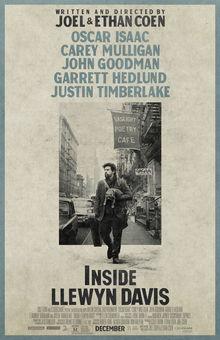
Inside Llewyn Davis

File:Inside Llewyn Davis Poster.jpgDirectors: Joel and Ethan Coen
Genre: Drama
Starring: Oscar Isaac, Carey Mulligan, Justin Timberlake, John Goodman
Distributed by: CBS Films
Release Date: December 13, 2013
My Rating: 7/10

The Coen brothers reunite to tell yet another story. This one is about up-and-coming folk singer in New York's Greenwich Village during the early 1960s. Llewyn Davis (Isaac) is a young broke musician who does not seem to have a fixed home and crashes with different friends every night, including a professor from Columbia University named Gorfein-whose cat he often loses-, his sister and nephew, and a young couple: Jean and Jim Berkey (Mulligan and Timberlake). He attempts to collaborate with numerous other artists, including Jim and another young singer-songwriter named Al Cody, hoping to share royalties with them.
Llewyn soon learns that Jean is pregnant and that she fears the child may be his. Jean then angrily tells him to help her pay for the abortion. Soon afterward, we learn that Llewyn was previously involved with another woman who also decided to receive an abortion after an unwanted pregnancy and move to Akron, Ohio.

Determined to make a name for himself and hopefully gain more royalties for each song he records, Davis heads west to Chicago, hitching a ride with a cynical jazz musician named Roland Turner (Goodman) and an quiet beat poet named Johnny Five (Garrett Hedlund). After being detained by a police officer, Llewyn eventually decides to return to New York and settle a deal to pay back his dues and rejoin the merchant marine union, an organization he formerly belonged to.

The film is very poignant, in the sense that the dialogue, music and general mood-as conveyed by the omnipresent bluish and grayish tones as well as the whiteness of winter-all reflect how dark and tense the characters are and how grim the prospects are for this young folk singer who desperately aspires to become a prominent musician like Bob Dylan. Even the seemingly jovial tune "Please Mr. Kennedy," sung by Isaac and Timberlake, contains a dose of pleading fear. Although this appears to be a typical struggling-artist story with a very simple plot, the Coen brothers nevertheless manage to create a very realistic portrait of the perseverance of a man who is mocked, insulted, and screamed at by nearly everyone around him and who seems to be told by most of humanity that unless he ceases to live in a world of idealism and becomes less co-dependent, he will never truly achieve his goals.

Of all the performances in the movie, one in particular stood out for me: that of Carey Mulligan, who plays a frustrated ex-lover of the protagonist, struggling every day to find happiness and remain sane. Mulligan is clearly a one-of-a-kind thespian of her generation, embodying the role of the woman who steadfastly refuses to endure the excuses of a man hoping for a miracle and without the slightest hint of a sense of direction in his life as an artist.

With an incredible soundtrack that includes Oscar Isaac, Marcus Mumford, and the Punch Brothers, Inside Llewyn Davis is a motion picture whose power is undeniable.


Sunday, February 9, 2014

Saving Mr. Banks

File:Saving Mr. Banks Theatrical Poster.jpgDirector: John Lee Hancock
Genre: Historical comedy-drama/Family
Starring: Emma Thompson, Tom Hanks, Paul Giamatti, Colin Farrell, Jason Schwartzman, B.J. Novak
Distributed by: Walt Disney Studios
Release Date: December 13, 2013
My Rating: 9/10


This film definitely snags a spot on my top favorite list of films of this past year. This is the story of P.L. Travers, the legendary author who created the character of Mary Poppins. The tale begins in 1906 in Maryborough, Australia, where a young girl named Helen Goff (Travers' birth name) is playing with her father Travers Goff (Farrell), a local bank manager whose battle with alcoholism is putting his profession at risk. The film then fast-forwards to the year 1961 in London, where Mrs. Travers (Thompson) is persuaded by her agent to travel to Los Angeles in order to grant Walt Disney (Hanks) the rights to turn her novel into a movie. Disney had been attempting to convince her to do this for 20 years-after a promise he made to his daughters when they told him that Mary Poppins was their favorite book-but the novelist had resisted the opportunity to collaborate. Travers finally and reluctantly agrees and flies to L.A, where she immediately becomes exasperated by the overly jovial and casual behavior of the residents of the city of angels: a culture shock of sorts to say the very least. After settling into her hotel, Travers is introduced to Walt Disney himself, along with the team with whom she will collaborate in the making of the film: screenwriter Don DaGradi (Bradley Whitford) and music composers Robert (Novak) and Richard Sherman (Schwartzman). The film goes on to demonstrate the process that took place to create the film, specifically the musical process, and what a cold and difficult person Mrs. Travers was to work with. She believes that none of these people understand the true nature and message behind her beloved story, and think that it is merely a fantastical and whimsical tale. The recurring flashbacks of Travers' harsh upbringing provide a backdrop for her current personality.

This is a very heartwarming film that audiences of all ages can enjoy from beginning to end. The switches back and forth between time periods appear rather frequent at first, but gradually become much more crucial in explaining the character of Helen Goff/PL Travers. Emma Thompson delivers a stunning performance as an uptight, patronizing woman with an overly pessimistic life view who is bound to quickly frustrate the viewer nearly as much as the other characters. The soundtrack, which includes the classic songs "Spoonful of Sugar" and "Let's go fly a kite" is also beautiful, reminding us how classic Disney films bring out the inner child in all of us by filling our souls with blissful joy. Unlike many traditional Disney movies, however, there is a rather dark and human backstory that is in stark contrast with the jovial musical numbers. Another noteworthy performance is that of Colin Farrell, who portrays the irresponsible but well-meaning father figure who much like Peter Pan, refuses to grow up. Finally, the film contains a pleasant surprise with regards to the identity and role of the nanny Travers met as a little girl who inspired the character of Mary Poppins.

One thing remains absolutely clear about films like this one: they serve to demonstrate that fairy tales and music can be a marvelous way of helping us to forget life's harsh miseries, even if their relief is merely transient. This film helps prove that we can all bring out the best in even the most placid and stolid people by doing something as simple as creating a beautiful melody and coupling it with a few magic words.      

Wednesday, February 5, 2014

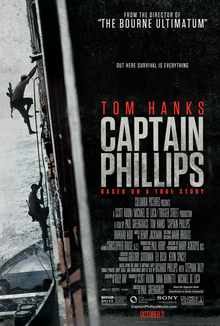
Captain Phillips

File:Captain Phillips Poster.jpg

Director: Paul Greengrass
Genre: Action thriller
Starring: Tom Hanks, Catherine Keener, Barkhad Abdi 
Distributed by: Columbia Pictures
Release Date: October 11, 2013
My Rating: 8.5/10


In light of the approaching Academy Awards, I decided to offer my take on one of this past year's Oscar-nominated films. Paul Greengrass (The Bourne Ultimatum) directs this true story about the April 2009 hijacking of the MV Maersk Alabama, the first American vessel to be attacked on the high seas in over 200 years.

Captain Richard Phillips (Hanks) prepares to depart from Oman to carry food and other supplies to Mombasa, Kenya through the Gulf of Aden, an area Philipps and his crew have been warned is notorious for piracy. One morning, the cargo ship is approached by two skiffs driven by a band of Somali Pirates about 240 miles off the coast of Somalia. The crew are able to deter them momentarily and alert naval authorities and although some fall behind and return to their homeland, four armed pirates eventually manage to reach the ship and board it by using a ladder. Phillips tells the majority of his crew to hide in the engine room at the bottom of the ship. Leading the criminals is a young man named Abduwali Muse (Abdi), who begins by breaking into the main control room of the ship and holding the Captain and a few other members of his unarmed crew at gunpoint. They try to assuage the fears of Phillips and the first officers, telling them they will not hurt anybody so long as they are allowed to take control of the vessel and take with them everything on it, including the supplies and $30,000 stored in a safe. Muse explains that he wants much more money than that, and that he plans to hold the ship and crew for ransom in exchange for million dollars in insurance from the shipping line company so that he may bring it home to his boss in Somalia. After a series of confrontations between the crew and the pirates, the criminals kidnap Phillips and escape in the Alabama lifeboat. This prompts the crew to alert a USS destroyer and the US Navy, who engage in a standoff with the pirates in an attempt to recuperate the Captain that lasts several days.

The film begins rather quickly, the actual hijacking of the ship occurring in the first few scenes. Right from the very beginning, the viewer experiences the terror felt by the crew members as the band of pirates boards the Maersk Alabama in such a violent and ruthless manner. There are a number of heart-pounding sequences in which one simply cannot correctly predict what will occur next, and the film demonstrates how far these criminals on the high seas are prepared to go in order to obtain what they want (or at the very least what their leaders want). The film also shows how many of the characters slowly begin to lose their sanity for different reasons, and how one Captain and his crew refused to give up until they were safe and until justice was ensured. Both Hanks and Abdi deliver stunning performances as the cautious Captain and the determined and ruthless pirate leader respectively, both engaging in a series of verbal exchanges that send chills through one's spine, each trying his best to stand his ground and figure out his opponent's next move.
One thing that I did find rather surprising was the fact that there are no major weapons on the ship for the crew to defend themselves in such dangerous waters.
It also seemed rather impressive that such a large rescue team was enlisted in order to save one person, and that the pirates were able to hold the Captain hostage for so many days while being surrounded by multiple Navy ships.
Finally, I although the film did show how much trauma the Captain suffered following his kidnapping, I would have wished the director had added a few more minutes to demonstrate how the aftermath of the hijacking and standoff affected future piracy attempts and other criminal activities in the area. 

The movie is based on a memoir written by the real Richard Phillips himself, and thus lends itself to be criticized by many as being inaccurate and depicting the Captain as more of a hero than he truly was. Nevertheless, one thing remains true: this film goes to prove that in some areas of the world, no one is truly safe and everyone can risk being attacked by even the most unexpected enemy.        
  

Tuesday, February 4, 2014

The Hunger Games: Catching Fire


File:Catching-Fire poster.jpg  

Director: Francis Lawrence
Genre: Adventure/Sci-Fi
Starring: Jennifer Lawrence, Josh Hutcherson, Woody Harrelson, Elizabeth Banks, Philip Seymour Hoffman
Distributed by: Lionsgate
Release Date: November 22, 2013
My Rating: 7.5/10

Albeit rather late, I wanted to post this review in honor of the late great Philip Seymour Hoffman, who passed away this past Superbowl Sunday from a tragic overdose. Mr. Hoffman was widely regarded as an incredibly prolific actor known for several films including Capote, Doubt, and The Master.

From I am Legend director Francis Lawrence comes the second installment in the  critically-acclaimed Hunger Games saga based on the young adult novels by author Suzanne Collins.
The first film depicts a corrupt government located in a dystopian fictional nation known as Panem, where a lavish Capitol governs 12 districts from which each year, one teenage boy and girl are sent to fight to the death in a brutal competition reminiscent of the era of gladiators in ancient Rome.

In this sequel, Katniss Everdeen (Lawrence) and Peeta Mellark (Hutcherson) are enjoying their newly-acquired status as champions of the 74th Hunger Games and are parading around the 12 districts with their team of sponsors which include Capitol resident Effie (Banks), mentor Haymitch (Harrelson) and stylists Cinna (Lenny Kravitz) and Portia as part of their victory tour to pay their respects to the fallen tributes from last year's hunger games. After a visit from Panem President Snow (Sutherland), Katniss learns that her actions in the previous games have sparked rebellions across the districts, prompting the Peacekeepers to maintain order by all means necessary, including public assassinations. Haymitch explains to Katniss and Peeta that in order to avoid any suspicions, they must become engaged so that their romantic relationship appears more plausible. There is also a new head game-maker, Plutarch Heavensbee (Hoffman) who has replaced Seneca Crane, who was executed for violating the game rules the previous year.  This year, as it marks the 75th Hunger Games, there is a "Quarter Quell" in which previous games victors from other districts compete against each other as tributes. Among them are Capitol favorite Finnick Odair from district 4, district 7 tribute Johanna Mason, and elderly couple Wiress and Beetee from district 3. Throughout the course of the games, the tributes battle various obstacles in the arena ranging from poisonous fog to wild monkeys and deafening birds known as jabber jays.

The film begins rather slowly, as much of the first half is devoted to the preparation for the games, the victory tour, and the rebellions that cause the Peacekeepers to resort to violence (as in one scene where Katniss's childhood friend Gale is whipped). However, once the games begin the action picks up and the numerous traps that the characters encounter are portrayed in very gripping and suspenseful ways, with various unexpected plot twists (particularly at the end) for anyone who didn't read the book. Moments of silence are quickly followed by scenes filled with heart-wrenching sounds and cries of anger during fight sequences. For the most part, the sequence of events does seem to follow those in the novel, although one crucial scene toward the end in which the tributes finally discover the secret to escaping the arena appeared rather rushed in my opinion, in stark contrast with the detailed description in the book. The new characters who appear as tributes in this installment are also not as well developed in this film as they are in the novel. Nonetheless, the cinematography and special effects remain fantastic, depicting a setting and scenes very similar to the ones I had pictured. when reading the book. The misery and anger that prevails in the districts at the beginning of the story are very well demonstrated, with a series of brutal scenes depicting signs of a revolution that will eventually unfold and gain force in the last novel, Mockingjay. The movie ends with exactly the same suspense with which the novel ends, predicting a bleak future ahead for the citizens of Panem.

The performances from the actors, both returning and new, are stellar, particularly Woody Harrelson as the gruff yet sly Haymitch Abernathy. Josh Hutcherson's portrayal of Peeta seemed rather lackluster compared to his performance in the previous film and especially next to the over-emotional and vehement Jennifer Lawrence, but that may simply be due to the fact that Peeta does not seem to play as strong a role as he did in the first movie. The film also has a brilliant soundtrack-which includes an original song "Atlas" by my one of my all-time favorite bands, Coldplay-that perfectly captures the anxious mood that prevails during the story.

Like most contemporary science fiction/fantasy films, this one demonstrates that the driving forces behind its success do not simply involve a series of dazzling visual effects and unfettered violence-and even a romantic subplot-but also the continuing faith of its fans that the story is not yet quite over, that there is still more to come.

Wednesday, January 15, 2014

Nosotros Los Nobles (We are the Nobles)

File:Nosotros los Nobles poster.jpg
Director: Gary Alazraki
Genre: Comedy (Mexico)
Starring: Gonzalo Vega, Karla Souza, Luis Gerardo Mendez, Juan Pablo Gil
Distributed by: Warner Bros. (Alazraki Films Studio)
Release Date: March 28, 2013
My Rating: 9/10

Newcomer young director Gary Alazraki directs his first full feature-length film that broke box office records throughout Mexico. German Noble (Vega) is a wealthy widower whose three adult children-Javi (Mendez), Barbara 'Barbi' (Souza), and Carlos 'Cha' (Gil)-have depended on him their entire lives. Javi, the eldest, occasionally assists his father at his company but spends most of his time partying and traveling with his friends and creating inane and far-fetched business ideas like 'VIP Gas stations' that deliver service to your car at your house. Barbara is about to marry a much-older spanish man named Pedro who has had numerous financial problems and hopes to benefit from Barbara's wealth. Cha, the youngest, has just been expelled from his university for bribing/sleeping with one of his professors and for using drugs. To top it off, all three of German's children have been spending extravagantly, as evidenced on their credit card statements. German thus suffers a mild heart attack as a result.
In order to teach them a valuable life lesson about hard work, German decides to forge a plan: One day, he stages a police appearance at their house, and tells his kids that their house is under foreclosure and that his company is being investigated for fraud and hence the government is taking all of their possessions. As Barbara angrily exclaims: "Can somebody explain to me why they're taking all our stuff as if we were in Venezuela or something?" He cancels their credit cards and takes their cell phones from them. As a result of their eviction, the 4 Nobles are forced to move into a ramschackle house on the opposite end of Mexico City where an old member of the family supposedly used to live. German thus tells his three children that in order to make ends meet, they will be forced to do something they have never done before: get a job. Cha thus begins working as a bank teller, Javi as a city bus driver, and Barbara as a waitress along with her former nanny's nephew Lucho.
Over several weeks, the 4 family members begin to grow significantly closer, learn more about each other and learn to survive in less-than-ideal conditions.
The film is a very idiosyncratic and genuine portrayal of contemporary Mexican society, both upper-class and working class, and is filled with numerous exaggerated and cartoonish yet eerily accurate stereotypes. For instance, that of the 'hipster' embodied by Cha, who wears winter hats, huge frame-rimmed glasses, smokes weed and frequently attends silent retreats, or Barbi as the princess who complains non-stop about petty issues and inserts random English words and expressions into her sentences like 'huge' and 'gross' in what appears to be an attempt to sound like an American valley girl. Or Javi, the arrogant aspiring entrepreneur who is surrounded by a posse of puerile friends just like himself.
Although cliche at various instances and ripe with raunchy and eye-rolling humor, the film does present mild doses of drama and down-to-earth moments. The three lead actors deliver stunning, laugh-out-loud performances as a trio of spoiled rich kids struggling to make something of themselves by reaping the rewards of their simple jobs. Director and writer Alazraki has created an amazing riches-to-rags story that conveys messages about family relationships, work ethics, and money in a city with incredibly large gaps between rich and poor.